
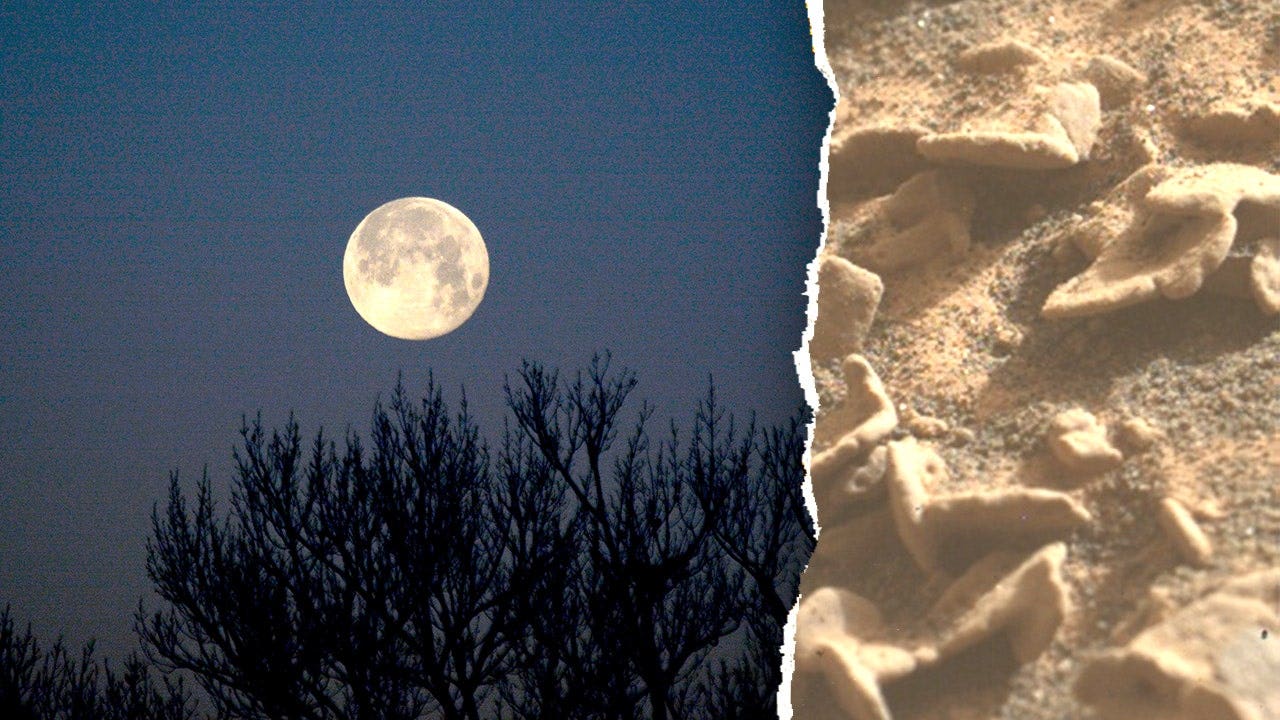

NASA scientists are investigating unusual “potato chip-shaped” formations on Mars as they seek to determine how these shapes formed — and just what they’re made of, exactly.The news was announced in NASA’s “Curiosity” blog on Nov. 11.Curiosity is a NASA rover that has been exploring Mars since 2012. It examined the unusual formations during a drilling campaign at a site nicknamed “Nazca” last week.TREASURE HUNTER STRIKES GOLD WITH 1,000-YEAR-OLD DISCOVERY LINKED TO ‘HAND OF GOD’The Nazca drill site is located in a Martian area where scientists have observed unusual disk-shaped features in the bedrock.”This is an area characterized by bedrock containing disk-shaped (or, in a liberal interpretation, potato-chip shaped) crystal forms,” the NASA blog said.Images of the Martian bedrock show irregular, curled formations embedded in the rock, some with shapes resembling potato chips.PUZZLING SOUND IN BACKYARD LEADS HOMEOWNER TO MASSIVE 1,000-YEAR-OLD TREASURENASA said one of its key objectives is to “better characterize these chip-shaped features.”Samples collected from the Nazca drill hole were delivered to Curiosity’s Sample Analysis at Mars (SAM) instrument, an onboard laboratory designed to analyze the chemical makeup of Martian samples.CLICK HERE TO SIGN UP FOR OUR LIFESTYLE NEWSLETTERCuriosity also planned to use its laser-equipped ChemCam instrument to examine a crystal-shaped formation nicknamed “Colca” to gather information about its chemical composition.Scientists also planned to use the Mars Hand Lens Imager (MAHLI), a camera mounted on Curiosity’s robotic arm, to photograph the crystal-shaped formations at night using white-light and ultraviolet LED lamps.CLICK HERE FOR MORE LIFESTYLE NEWS”ChemCam LIBS observations were planned for each sol including a cluster of crystal forms, a resistant layer in the side of the Nazca block and a dark float rock,” NASA’s blog stated.The rover was then expected to leave the Nazca drill site and return to its southward route to continue exploring Mars as part of its Friday plan.Fox News Digital reached out to NASA to ask more about the chip-shaped formations and whether they’ve been observed before.TEST YOURSELF WITH OUR LATEST LIFESTYLE QUIZThe unusual formations are among the latest objects being studied as scientists continue to explore Mars and other parts of the solar system.Last month, astronomers discovered a potential dwarf planet beyond Pluto using the Vera C. Rubin Observatory in Chile.The object, named 2026 ED138, is estimated to measure between 370 and 930 miles across, potentially making it one of the largest dwarf planets ever discovered in the distant solar system.